
Main Courses
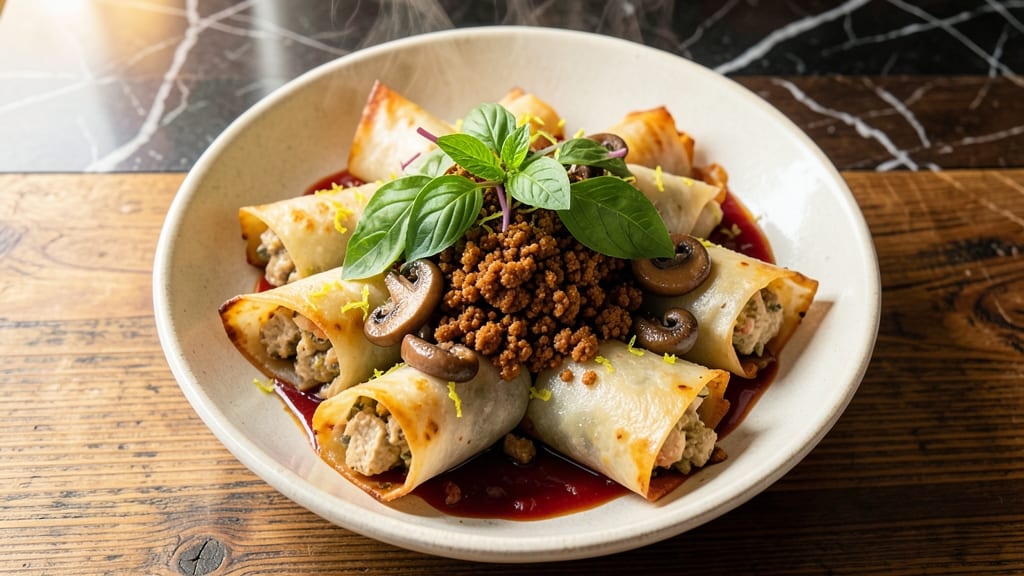
This cha gio recipe with rice paper delivers the perfect balance of crispy golden exteriors and tender fillings that burst with every bite.
The secret lies in a delicate tofu-mushroom-herb mixture wrapped in rice paper and fried to irresistible perfection—each dumpling shatters with a satisfying crunch while keeping its filling moist and flavorful inside.
What sets these Vietnamese spring rolls apart is the technique: rolling tightly for structural integrity and frying at the right temperature to achieve that signature crispy texture without sacrificing the fresh, herby filling. The result is a dish that’s both restaurant-quality and surprisingly simple to master at home.
Ingredients for cha gio recipe rice paper
Eight essential ingredients create restaurant-quality Vietnamese spring rolls with perfect crispy texture and herby filling.
| Ingredient | Amount | Notes |
|---|---|---|
| Rice Paper Sheets 🍱 | 8 whole | Medium size, 7-inch diameter |
| Extra-Firm Tofu 🧀 | 14 oz | Pressed and crumbled finely |
| Shiitake Mushrooms 🍄 | 8 oz | Stems removed, finely chopped |
| Green Onions 🧅 | 4 whole | White and green parts separated |
| Fresh Thai Basil Leaves 🌿 | ½ cup | Finely chopped, stems removed |
| Lime Zest 🍋 | 1 tbsp | Freshly grated |
| Fish Sauce 🍶 | 1 tbsp | Vegetarian alternative (soy sauce) |
| Sugar 🍚 | 1 tbsp | White granulated |
| Vegetable Oil 🫒 | 3 cups | For deep frying, 350°F |
| All-Purpose Flour 🌾 | ¼ cup | For dusting work surface |
| Salt 🧂 | ½ tsp | Diamond Crystal preferred |
| Black Pepper 🌶️ | ¼ tsp | Freshly ground |
| Garlic Cloves 🧄 | 4 cloves | Minced finely |
The rice paper is non-negotiable—Vietnamese rice paper sheets from Asian markets yield the best results. Look for medium 7-inch diameter sheets (7cm) that feel sturdy yet pliable. Freshness matters: store unopened sheets in the fridge, and once opened, keep them submerged in water until use. For the tofu, extra-firm is critical—press it for 30 minutes between paper towels to remove excess moisture. Trader Joe's and H Mart carry excellent quality, but any reputable grocery store with an Asian section should have suitable options.
Substitutions are possible but require finesse. No fish sauce? Use soy sauce plus a pinch of sugar to mimic the umami-sweet balance. Fresh Thai basil unavailable? Substitute with a mix of sweet basil and cilantro (though the flavor won't be identical). The mushrooms can be swapped for oyster mushrooms or even finely chopped cremini, but shiitake's earthy depth is ideal. Vegetable oil substitutes like peanut or avocado oil work, but ensure they have a high smoke point for frying. For the lime zest, bottled won't cut it—fresh is essential for that bright, citrusy punch that cuts through the richness.
Rice paper sheets keep best in the fridge, sealed in a plastic bag with a damp paper towel to prevent drying. Use within 1 week of opening for optimal texture. The filling mixture can be prepped 1 day ahead and stored in an airtight container—it actually develops more flavor overnight. For frying, maintain oil temperature at 350°F using a deep-fry thermometer. Portion dumplings into single servings immediately after frying to prevent sogginess, and serve with sweet chili sauce or hoisin for dipping.
Why You'll Love This Recipe
- No-Fuss Assembly: I swear, these little rolls take less time than ordering takeout. Just soak the rice paper, layer tofu and mushrooms, fold—boom. No frying, no fuss, and no one’s standing over a stove for hours.
- Umami Bomb: That combo of crispy tofu, earthy shiitakes, and fresh Thai basil? It’s like a flavor party in your mouth. The mushrooms add depth, while the basil keeps it bright—no bland bites here.
- Lunchbox Hero: Pack these for work or school—no reheating needed. They hold up better than most wraps, and the kids (or my picky husband) will actually eat them. Cold or warm, they’re a hit.
- Budget Win: Tofu and mushrooms stretch this recipe far. I make a double batch, freeze extras, and still save money. Plus, rice paper is cheaper than takeout, and the leftovers? Even better the next day.
Step-by-step instructions for crispy-fried Vietnamese dumplings
Master the art of cha gio with this precise method for golden, shatteringly crisp dumplings.
Prepare the Filling with Perfect Texture
In a large bowl, combine the 14 oz extra-firm tofu (pressed and crumbled), 8 oz finely chopped shiitake mushrooms, white parts of 2 green onions (finely minced), 4 cloves minced garlic, 0.5 cup finely chopped fresh Thai basil leaves, 1 tbsp lime zest, 1 tbsp fish sauce, 1 tbsp sugar, 0.5 tsp salt, and 0.25 tsp black pepper. The tofu should be completely broken down into pea-sized pieces for even cooking.
Use your hands to gently mix all ingredients until thoroughly combined. The filling should be moist but not soupy—if it's too dry, add 1-2 teaspoons of water. This mixture forms the heart of your dumplings, so ensure every component is finely chopped for uniform texture. Set aside while you prepare the rice paper wrappers.
Assemble the Dumplings with Precision
Fill a shallow bowl with warm water and let the 8 rice paper sheets soak for 10-15 seconds each until pliable but still slightly firm. Work with one sheet at a time to prevent drying. Place a sheet on a clean surface and spread 1 heaping tablespoon of filling in the center, leaving about 1 inch of border around the edges.
Fold the bottom of the sheet up over the filling, then fold in the sides, and finally roll the top down to create a neat cylinder. Press gently but firmly to seal the edges—this ensures they hold together during frying. Keep assembled dumplings on a floured surface to prevent sticking. The goal is to create tight, compact packages that will fry evenly.
Create the Crispy Outer Layer
In a separate bowl, mix 0.25 cup all-purpose flour with 0.5 tsp salt. Lightly coat each assembled dumpling by rolling it in the flour mixture, pressing gently to adhere. This flour crust is what creates that signature crispy exterior. Arrange the coated dumplings on a floured plate and let them sit for 5 minutes to develop a light crust.
Real talk: Don't skip this flouring step. It's what transforms good dumplings into exceptional ones. The flour creates a protective barrier that prevents the rice paper from getting soggy while frying, and it's what gives that satisfying crunch when you bite in.
Fry to Golden Perfection
Heat 3 cups vegetable oil in a deep fryer or heavy pot to 350°F. Use a candy or deep-fry thermometer for accuracy—this temperature is crucial for even cooking. Fry 4-5 dumplings at a time, turning occasionally with tongs, for 3-4 minutes until they turn a deep golden brown and float to the surface. This indicates they're fully cooked through.
Remove fried dumplings with a slotted spoon and drain on a wire rack or paper towels. The oil temperature will drop as you add more dumplings, so maintain 350°F by adding oil as needed. Don't overcrowd the pan—this lowers the oil temperature and leads to greasy, unevenly cooked dumplings. Each batch should crisp up beautifully for that satisfying crunch.
Serve Immediately with Fresh Garnishes
Transfer the crispy cha gio to a serving platter and immediately garnish with the green parts of 2 green onions (finely sliced) and any remaining fresh Thai basil leaves. Serve warm with a side of sweet chili sauce or hoisin for dipping. These dumplings are best enjoyed immediately while still crispy—every bite should deliver that perfect contrast of crunchy exterior and tender, flavorful filling.
The secret to maintaining crispiness is serving them right away. If you need to hold them briefly, keep them in a 200°F oven on a wire rack for no more than 10 minutes. The combination of proper frying technique and immediate serving ensures you deliver on that promised crispy texture with every bite.
Pro Tips For Making Cha Gio Recipe Rice Paper
- SOAK RICE PAPER RIGHT: Fill a shallow bowl with warm (not hot) water—about 80°F—and let the sheets soak for 15-20 seconds max. They’ll soften just enough to wrap without turning to mush. I learned this the hard way—over-soaking makes them limp and impossible to fold neatly. Keep a damp towel nearby to prevent drying while you work.
- PRESS TOFU DRY: After pressing extra-firm tofu, pat it thoroughly with paper towels—don’t just wipe the surface. The goal is to get it bone-dry so it absorbs the filling’s flavor and doesn’t make your cha gio soggy. I used to skip this, and my wraps always felt damp inside. Trust me, the texture difference is night and day.
- STIR-FRY MUSHROOMS FAST: Slice shiitake mushrooms thinly (1/8-inch or less) and cook them separately in a hot, oiled pan for 2-3 minutes until they release their water. Then toss them into the filling mix—this keeps your cha gio from turning into a waterlogged mess. I was skeptical until I tried it; now I never skip this step.
- WRAP TIGHT, SEAL QUICK: Work in batches and seal the edges firmly with your fingers before rolling. A loose wrap will unravel when frying, and a half-open cha gio won’t crisp properly. Pro tip: Use a damp paper towel to smooth the edges if they resist—it gives you better grip than dry fingers. This isn’t the prettiest method, but it’s the tastiest.
Essential equipment for great cha gio recipe rice paper
Rice Paper Prep Essentials
You’ll need 8 medium rice paper sheets (7-inch diameter) for perfect cha gio. I recommend Vietnamese rice paper from trusted brands like Thai Kitchen or H Mart—these are thicker and hold their shape better during frying.
Store unopened sheets in the fridge, and once opened, keep them submerged in warm water until use to prevent drying. A wide, shallow bowl works best for soaking, and a clean work surface (preferably floured) is crucial for rolling. 🍱
Frying Setup Must-Haves
For crispy results, invest in a deep-fry thermometer—I swear by the Thermoworks Smoke—to maintain 350°F oil temperature precisely. A heavy-bottomed pot (like All-Clad) or a deep fryer prevents temperature fluctuations.
Use 3 cups vegetable oil (peanut or avocado oil also work) and a slotted spoon for easy turning. A wire rack or paper towels is essential for draining fried dumplings to keep them crispy. 🔥
Rolling Tools for Precision
While no fancy tools are required, a small offset spatula helps spread filling evenly on rice paper sheets. For sealing, I keep a damp paper towel nearby to moisten any dry edges during rolling.
A floured plate (with all-purpose flour) prevents sticking when coating dumplings. For garnishing, sharp kitchen shears make quick work of slicing green onions and Thai basil. 🌿
Safety Gear for Frying
Never skip heat-resistant gloves when handling hot oil or dumplings. A tongs set (like OXO Good Grips) makes turning dumplings safer and more precise. Keep a fire extinguisher nearby—though rare, oil splatters can happen.
I also recommend a small fan to clear steam while frying for better visibility. Safety first, crispy second! ⚡
Storage Solutions
For leftovers, store fried cha gio in an airtight container at room temperature for up to 2 days (though they’re best fresh). If reheating, use the oven at 350°F for 5 minutes on a wire rack to restore crispiness.
For the filling mixture, an airtight glass container keeps it fresh for 1 day in the fridge. A damp paper towel in the container prevents drying. 💫
Nutrition facts
Frequently asked questions
Can I make vegetarian cha gio without fish sauce?
Replace fish sauce with 1 tbsp soy sauce plus ½ tsp sugar to mimic the umami-sweet balance. For extra depth, add ½ tsp vegetarian oyster sauce or a pinch of MSG. The filling will still pack incredible flavor without compromising the authentic taste.
Why did my rice paper wrappers tear when rolling?
Rice paper tears most often from either over-soaking (making it too soft) or uneven filling distribution. Soak sheets for just 10-15 seconds in warm water, then work quickly. Spread filling in a small mound rather than a wide layer, and keep your hands dry when handling. A lightly floured surface also helps prevent sticking.
How do I keep the filling from leaking during frying? Tight rolling is key! Press the edges firmly as you fold, and use 1 heaping tbsp of filling per dumpling (not more). The flour coating creates a protective barrier—
Can I bake these instead of frying for a healthier option?
Yes, but expect a different texture. Brush assembled dumplings with 1 tbsp oil and bake at 400°F for 15-18 minutes until golden. For extra crispiness, broil for 2-3 minutes at the end. They'll be softer than fried but still delicious—just not that satisfying crunch! Pair with extra dipping sauce to compensate.
What's the best way to reheat leftover cha gio?
For maximum crispiness, place on a wire rack and bake at 375°F for 5-7 minutes. Avoid microwaving—they'll turn soggy. If you must use the air fryer, reheat at 350°F for 3-4 minutes (spritz lightly with oil first). Leftovers stay fresh for 2 days at room temperature, but they're best enjoyed immediately after frying.