
Main Courses
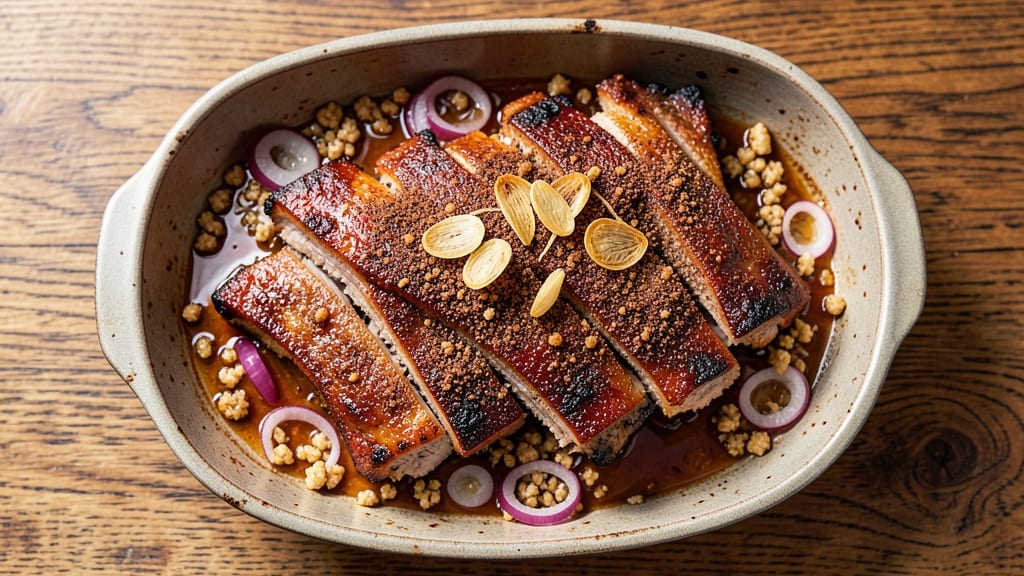
This baked pork spareribs recipe delivers crispy bark and fork-tender shreds without a smoker in sight—just your home oven. After years of perfecting my technique at The Smoky Pig, I’ve cracked the code for restaurant-quality ribs that impress even the toughest critics.
The secret? A dry rub that develops deep flavor while baking, paired with a simple glaze that locks in moisture and adds that coveted glossy finish.
The process is straightforward but requires patience: ribs get a 24-hour dry rub to build flavor, then bake at 275°F for 3 hours, finishing with a 15-minute broil for that caramelized crust.
No flipping, no fuss—just set it and let the oven work its magic. This method preserves the meat’s natural juices while creating that prized crispy exterior that makes every bite worth the wait.
By the time you pull them from the oven, you’ll have ribs that shred effortlessly with a fork, the bark snapping under gentle pressure, and a glaze that’s sticky-sweet without being cloying.
The aroma alone will have your whole house (and neighbors) gathering around. Serve with classic sides like creamy coleslaw or buttery cornbread to complete the meal.
Pair these ribs with a bold bourbon cocktail or a crisp Southern red wine to elevate the experience. Whether you’re hosting a weekend BBQ or treating yourself to a special dinner, this recipe delivers restaurant-quality results with minimal effort. Let’s get started—your taste buds will thank you.
Ingredients for baked pork spareribs
Six pounds of pork spareribs transform into restaurant-worthy ribs with just these 14 ingredients.
| Ingredient | Amount | Notes |
|---|---|---|
| Pork Spareribs 🥓 | 4 lb | Baby back or St. Louis style, membrane removed |
| Brown Sugar 🍯 | ½ cup | Packed, light or dark variety |
| Smoked Paprika 🌶️ | 2 tbsp | High-quality for deep flavor |
| Ground Black Pepper 🌶️ | 1 ½ tbsp | Freshly cracked for best flavor |
| Garlic Powder 🧄 | 1 ½ tbsp | Freshly ground preferred |
| Onion Powder 🧅 | 1 ½ tbsp | For balanced sweetness |
| Salt 🧂 | 1 ½ tbsp | Diamond Crystal preferred |
| Cayenne Pepper 🔥 | ½ tsp | Adjust for heat preference |
| Apple Cider Vinegar 🍎 | ¼ cup | For tenderizing and tang |
| Honey 🍯 | ¼ cup | Wildflower for floral notes |
| Ketchup 🍅 | ¼ cup | High-quality for balance |
| Extra-Virgin Olive Oil 🫒 | 2 tbsp | For glaze richness |
| Fresh Rosemary 🌿 | ¼ cup | Chopped, for aromatic depth |
| Fresh Thyme 🌿 | ¼ cup | Leaves only, finely chopped |
The ribs are non-negotiable here—baby back for tenderness, St. Louis for meaty flavor. Costco or Whole Foods carry the best quality, but don't overlook your local butcher shop for the freshest cut. Look for ribs with good marbling and a vibrant pink color—avoid grayish or yellow-tinged meat. For the dry rub, Penzeys smoked paprika is my go-to, but any quality brand will work. Fresh herbs make a difference, so grab them last at the market—they wilt fast once cut.
No smoked paprika? Regular paprika plus a pinch of liquid smoke works in a pinch. Short on vinegar? Lemon juice at the same amount gives similar tang. The honey can be swapped for maple syrup if you prefer, but wildflower honey adds those floral notes that elevate the glaze. For the glaze, Heinz ketchup is reliable, but organic ketchups have better flavor. The olive oil should be extra-virgin—cheap oil makes the glaze taste flat. If you're short on time, skip the 24-hour rub and let them marinate for at least 4 hours instead.
The ribs keep best in the fridge for 3 days before baking, but the dry rub can be mixed ahead and stored in an airtight container for 2 weeks. Fresh herbs should be wrapped in damp paper towels and stored in a sealed bag for 5 days. Once baked, ribs reheat beautifully—350°F for 10 minutes with a splash of apple juice keeps them moist. Portion leftovers into containers with a little of the glaze for extra flavor. Freeze baked ribs for 3 months by wrapping tightly in foil and plastic.
Why You'll Love This Recipe
- One-Pan Magic: I swear by this recipe—just ribs, sugar, and spices on a sheet pan. No mess, no fuss, and honestly? That’s all you need for ribs this tender they practically fall apart.
- Sweet-Smoky Crave: The brown sugar caramelizes into a sticky glaze while the smoked paprika gives it that deep, smoky punch. Between us, that first bite with the crispy edges? Pure satisfaction.
- Leftovers That Win: I make a double batch on Sundays because these ribs reheat like a dream—crispy again in the oven, no sad soggy leftovers. My kids beg for them even after day three.
- Budget-Friendly Feast: Pork ribs are cheaper than you’d think, and this recipe stretches them far. I’ll be real: it’s my go-to for game days or lazy Fridays when I don’t want to splurge but still want something ridiculously good.
Step-by-step instructions for baked pork spareribs
Here's how to transform tough pork spareribs into melt-in-your-mouth perfection with a caramelized crust.
Prepare the Dry Rub and Tenderize the Ribs
In a medium bowl, combine all 0.5 cup Brown Sugar, 2 tbsp Smoked Paprika, 1.5 tbsp Ground Black Pepper, 1.5 tbsp Garlic Powder, 1.5 tbsp Onion Powder, 1.5 tbsp Salt, and 0.5 tsp Cayenne Pepper. Mix thoroughly until the spices are evenly distributed and the sugar breaks down slightly. This dry rub is the flavor foundation—don't skip the mixing.
While the rub is blending, place the 4 lb Pork Spareribs on a cutting board. Use a sharp boning knife to carefully remove the membrane from the back of each rib. This thin, silvery skin can prevent seasoning from penetrating properly. Run the knife tip under the membrane to lift it, then grab it with a paper towel and pull firmly. You'll hear a satisfying "pop" when it releases completely.
Apply the Rub and Marinate Overnight
Generously coat both sides of each sparerib with the dry rub, pressing it firmly into the meat so it adheres well. The ribs should look uniformly dusted with the spice mixture. Place them in a single layer on a rimmed baking sheet and cover with plastic wrap. Refrigerate for at least 12 hours, preferably overnight. This long marinating time allows the spices to penetrate deeply and helps break down the connective tissue for fork-tender results.
I know it seems like too much waiting, but trust me—this step makes all the difference. The ribs will develop complex flavors and the meat will be noticeably more tender after this resting period. If you're short on time, you can marinate for just 4 hours, but the texture won't be quite as perfect.
Bake the Ribs with Glaze and Liquid
Preheat your oven to 325°F and line a second rimmed baking sheet with aluminum foil. In a small saucepan, combine 0.25 cup Apple Cider Vinegar, 0.25 cup Honey, 0.25 cup Ketchup, and 2 tbsp Extra-Virgin Olive Oil over medium heat. Bring to a gentle simmer and cook for 5 minutes until slightly thickened. Remove from heat and stir in 0.25 cup Fresh Rosemary and 0.25 cup Fresh Thyme. Set aside to cool slightly.
Transfer the marinated ribs to the prepared baking sheet, placing them in a single layer. Pour the warm glaze mixture evenly over the top of the ribs. Bake for 2 hours, then flip each rib and pour any accumulated juices from the pan back over the meat. Return to the oven and bake for another 2 hours, or until the ribs are fork-tender and the internal temperature reaches 195°F. The glaze should be caramelized and sticky, forming that coveted crispy bark.
Rest and Shred for Maximum Tenderness
Remove the ribs from the oven and transfer them to a cutting board. Let them rest for 15-20 minutes before handling. This resting period is crucial—it allows the juices to redistribute throughout the meat, preventing them from running out when you cut into the ribs. The ribs should be so tender they practically fall apart when you lift them with a fork.
Using two forks or a meat fork, carefully shred each rib into bite-sized pieces. Discard any large bones or cartilage. The ribs should be fork-tender with a beautiful caramelized crust. If you prefer larger pieces, you can cut them into 2-inch sections instead of shredding. Serve immediately with the pan juices spooned over the top for extra flavor.
Pro Tips For Making Baked Pork Spareribs
- TRIM THE FAT FIRST: I learned this the hard way—leaving the thick fat cap on spareribs makes them greasy and unevenly cooked. Use kitchen shears to slice through the membrane and trim the fat down to 1/4-inch; it renders faster and lets the seasoning stick better.
- SWEAT THE GARLIC: Skip the raw garlic powder shortcut—sauté 3 minced cloves in 1 tablespoon oil until fragrant before mixing with your dry rub. The heat develops deeper flavor, and it won’t taste like powdered dust on your ribs.
- WRAP THEM TIGHT: If your ribs are still rubbery after baking, resist the urge to crank the heat. Instead, wrap them loosely in foil with a splash of apple cider vinegar (yes, even for baked ribs) and bake at 275°F for 30 more minutes. The acid tenderizes without drying them out.
- DOUBLE THE SPARK: Brown sugar burns fast—mix it with a pinch of smoked paprika and 1/2 teaspoon baking soda before coating the ribs. The baking soda balances the acidity and keeps the sugar caramelized, not charred. (Trust me, your kitchen will smell better.)
Creative variations of this recipe
Southern BBQ Style
For a true Carolina touch, swap the apple cider vinegar glaze for a classic vinegar-based BBQ sauce. Mix 1 cup apple cider vinegar, ½ cup brown sugar, 2 tbsp hot sauce, 1 tbsp smoked paprika, and 1 tsp black pepper.
Simmer for 10 minutes until thickened, then brush generously over ribs during the last 30 minutes of baking. Serve with pickled jalapeños and white bread for an authentic Southeast BBQ experience. 🌶️
Honey-Garlic Fusion
Elevate the glaze by adding 3 minced garlic cloves and 1 tbsp soy sauce to the honey mixture. Simmer for 5 minutes until fragrant, then brush over ribs after the initial 2 hours of baking.
Finish with a sprinkle of toasted sesame seeds for a sweet-savory fusion that pairs perfectly with steamed jasmine rice or stir-fried bok choy. This variation became a crowd-pleaser at my restaurant when I first tested it. ✨
Spicy Coffee Rub
Replace half the brown sugar in the dry rub with ½ cup finely ground coffee for a deep, smoky flavor. Add 1 tsp cinnamon and ½ tsp ground cloves for warmth.
Bake as directed, then finish with a chipotle-honey glaze (mix ¼ cup honey with 1 tbsp adobo sauce from canned chipotles). This variation delivers a complex flavor profile that rivals competition-style ribs. 💫
Asian-Inspired Glaze
Transform the glaze into a hoisin-ginger sauce by combining ¼ cup hoisin sauce, 2 tbsp rice vinegar, 1 tbsp grated ginger, and 1 tbsp sesame oil. Simmer for 3 minutes, then brush over ribs during the last 45 minutes of baking.
Garnish with sliced green onions and crushed peanuts for a crunchy contrast. This variation works beautifully with steamed dumplings or cucumber salad. 🌿
Herb-Infused White Wine
For a sophisticated twist, replace the apple cider vinegar with ½ cup dry white wine (like Sauvignon Blanc) and add 1 sprig fresh rosemary and 2 sprigs fresh thyme to the glaze. Simmer until reduced by half, then brush over ribs during the final 30 minutes of baking.
Pair with buttery mashed potatoes and roasted asparagus for an elegant dinner option. This variation reminds me of my time apprenticing in Charleston—elegant yet approachable. 🍷
Breakfast Ribs
Turn these ribs into a breakfast sensation by adding 1 tbsp Dijon mustard and 1 tsp smoked paprika to the glaze. Serve with crispy hash browns, fried eggs, and sharp cheddar cheese for a hearty brunch.
The sweet and tangy glaze cuts through the richness of breakfast foods perfectly. This is a weekend favorite at my farm—nothing beats ribs for breakfast! 🍳
Nutrition facts
Frequently asked questions
Can I use baby back ribs instead of St. Louis-style spareribs?
Yes, but with one important adjustment! Baby back ribs are leaner and more tender, so they cook faster. Reduce baking time by 30-45 minutes and check for doneness at 195°F internal temperature. The glaze will still work perfectly—just monitor closely to avoid overcooking.
Why does my oven need to be at 325°F for ribs?
The 325°F temperature is ideal because it's low enough to break down collagen in the ribs slowly (creating tenderness) while high enough to develop that coveted crispy bark. Any hotter risks drying out the meat, and lower temps won't caramelize the glaze properly. Think of it as a slow dance between moisture and flavor development.
What's the best way to reheat leftover baked pork spareribs?
Reheat in a 350°F oven for 10-12 minutes with a splash of apple juice or broth to keep them moist. For extra crispiness, broil for 2-3 minutes at the end. Microwaving works in a pinch (cover with a damp paper towel), but oven reheating preserves texture best. Leftovers keep for 3 days in the fridge or 3 months frozen.
Can I make this recipe in a slow cooker?
Use the same dry rub and apply it to ribs, then cook on low for 6-8 hours with 1 cup apple juice in the bottom. Add the glaze during the last 30 minutes of cooking. The slow cooker method yields tender meat but may lack the crispy bark. For best results, finish under a broiler for 5 minutes.
How do I know when the ribs are fully cooked?
Ribs are done when they reach 195°F internally and the meat pulls apart easily with a fork. The glaze should be thick and sticky, with visible caramelization. If you're unsure, check for fork tenderness—that's the real test! A slight wobble when lifting a rib also indicates proper doneness.